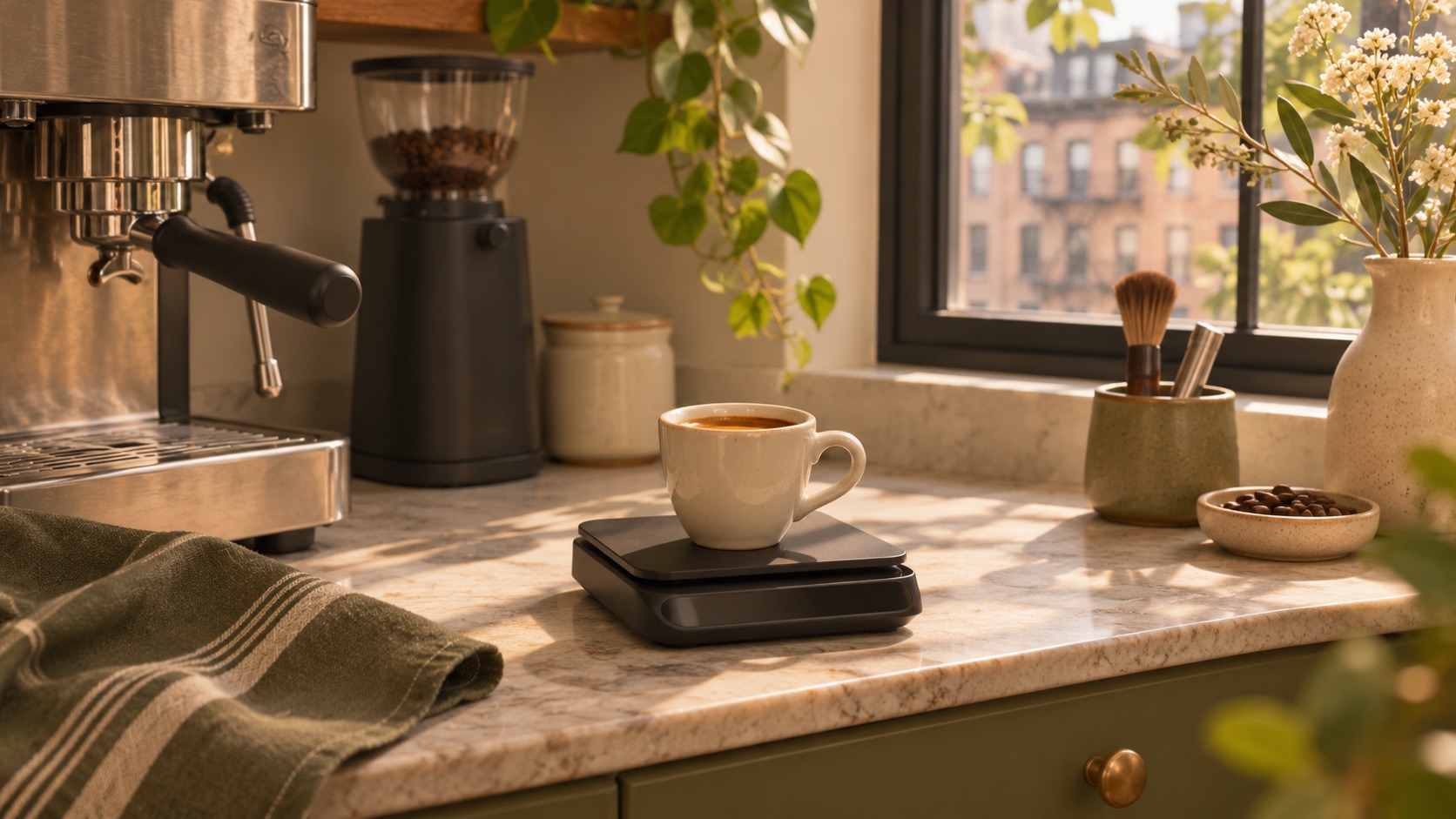
Start with your machine and coffee
A capsule machine does not need a separate grinder for its capsules. Some machines include a grinder; others accept ground coffee in a portafilter. Check the exact model and basket first. If you already use pre-ground coffee successfully, you can learn with it before buying equipment.
Match the basket to the adjustment
A pressurized basket can be a useful starting point for pre-ground coffee. A single-wall basket responds more directly to changes in grind and generally benefits from fine, repeatable adjustments. The basket, coffee and machine all matter; check the manufacturer’s instructions and do not assume the same setting works on a different grinder.
Look beyond the number of settings
Espresso uses a fine grind, but the number of advertised settings alone does not tell you whether the espresso range has useful steps. Stepped grinders move between defined positions; stepless adjustment allows movement between positions. Neither label proves drink quality. Check the maker’s espresso guidance, the adjustment method and support for your specific model.
Decide how you will dose
For single dosing, you weigh the beans for each preparation. A hopper can hold more beans; some grinders run for a set time, while others measure output by weight. A timer is not a scale: if consistency matters, weigh the coffee actually delivered to the basket; any grounds left in the dosing cup are not part of that dose.
Understand retention without guessing
Some grounds can remain inside a grinder or cling to a cup or chute. If 18 g goes in and 17.6 g comes out, the 0.4 g difference is an observation, not a reliable independent retention measurement: spills, scale resolution and previously retained coffee can affect it. Follow the maker’s instructions and test your own routine over several doses.
Manual or electric?
A hand grinder can be stored away and avoids a power cord, but each drink requires turning a handle. Consider grip, effort, number of drinks and the room needed to turn it. An electric grinder reduces that manual work, but check hopper access, sound, cleaning and the position of the outlet in a small apartment.
Measure the whole workflow
Measure the assembled grinder’s width, depth and height, not just the base. Leave room to load beans, remove a hopper or turn a handle, operate a portafilter and reach the cord. Check the holder and dosing-cup fit with your actual equipment; a nominal portafilter size does not guarantee a stable fit.
Plan for cleaning and support
Follow the exact unit’s cleaning instructions; unplug electric equipment before maintenance. On the Encore ESP, Baratza instructs users to brush the burrs and not wash them with water. Other machines differ. Check whether replacement burrs, parts, warranty and support are available for the actual seller and model.
Make the first adjustment
Use the manufacturer’s starting guidance, a dose suited to your basket and the same coffee. Record the setting, dose, beverage weight and taste. If flow is unusually fast, try a small step finer; if it nearly stops, stop the shot and, after checking the machine and basket, try coarser. Change one thing at a time and use your own taste.
Compare the full setup cost
Account for the grinder, coffee, any required scale or dosing cup and the space they occupy. A hand grinder can trade countertop space for manual effort; an integrated machine combines equipment but still requires room and maintenance. Check the current seller’s voltage, bundle and return terms before purchasing.
Four grinders, different routines
Features below come from manufacturer descriptions. We have not tested these products, and an espresso-capable grinder still needs dialing in for your coffee and machine.
| Model | Adjustment and dosing | What to consider |
|---|---|---|
| Baratza Encore ESP | Stepped hopper adjustment; maker identifies settings 1–20 for espresso | Measure each dose separately. Amazon and the manufacturer show different size figures; check the product details and cabinet clearance. |
| Baratza Sette 270Wi | Macro and micro adjustments; integrated scale doses by weight | Allows direct-to-portafilter dosing; check fit, height and selected voltage. |
| MiiCoffee DF54 | Stepless adjustment; single-dose workflow | Weigh beans for each dose and check the version and voltage with the seller. |
| KINGrinder K6 | Manual grinder with external stepped adjustment; maker specifies 16 microns per click | Requires hand grinding and handle clearance; check capacity and selected version. |
Space is more than a footprint: allow room for a scale when weighing beans, hopper or bellows access, the power cord and cleaning. Sources: Encore ESP · Baratza adjustment guide · Sette 270Wi · MiiCoffee DF54 · KINGrinder K6.
See the routine
Each is a manufacturer demonstration, not an independent review. Check your exact model and current instructions.
- Watch Encore ESP cleaning and maintenance by Baratza on YouTube ↗
The manufacturer demonstrates cleaning and reassembly of the Encore ESP grinder. - Watch Cleaning the Sette 270Wi by Baratza on YouTube ↗
A cleaning demonstration for the Sette 270Wi grinder.
YouTube opens separately.
Further reading
Ready to compare equipment?
Explore grinders ↗